

Quick Summary
- Map every learning outcome to at least one assessment in a simple matrix to spot gaps quickly.
- Score each assessment on validity, reliability, integrity, and accessibility using a 1 to 3 scale.
- Run a calibration pass with two reviewers on three assessments before starting the full audit.
- Redesign high-stakes tasks to require applied or process evidence rather than relying only on surveillance.
- Sort findings into fix now, fix next term, and monitor, each with an owner and a due date.
Table of Contents
- Why Online Course Assessments Need a Regular Audit
- Key Terms: Validity, Reliability, and Alignment
- Step-by-Step: Running Your Online Course Audit Checklist
- Formative vs Summative Assessment in Online Learning: What to Check
- Academic Integrity in Online Assessments: Common Audit Findings
- Accessibility and Learning-Platform Data in Your Audit
- Booking Your First Assessment Audit with Babb Education
- Frequently Asked Questions
Why Online Course Assessments Need a Regular Audit
Most online courses get built once and then left alone. The quizzes, exams, and projects go live, and nobody looks at them again until a student complains or an accreditor asks questions. By then, the online course assessment may no longer match what the course teaches.
An audit fixes that. It is a structured review of whether each assessment measures what it should, whether it is fair, and whether it still holds up against current tools and student needs. Think of it as a checkup, not a rebuild.
Colleges and universities that audit on a regular schedule catch problems early. Common ones include:
- Quiz questions that test recall when the outcome asks for analysis
- Multiple-choice banks that students have shared for years
- Assignments that generative AI tools can complete with a single prompt
- Rubrics that nobody applies the same way twice
If you run several programs, pick a rotating schedule so the work stays manageable.
Key Terms: Validity, Reliability, and Alignment
Before you start, agree on what you are checking. Three terms do most of the work.
Validity means an assessment measures the skill or knowledge it claims to measure. A quiz on memorized dates tests memory, not historical reasoning.
Reliability means the assessment gives consistent results. If two graders score the same essay very differently, the rubric needs work.
Alignment means the assessment matches the stated learning outcomes. Each outcome should have at least one assessment that targets it directly.
Keep these three in mind as you move through the checklist. Most audit findings trace back to one of them.
Step-by-Step: Running Your Online Course Audit Checklist
A workable audit follows a clear sequence and leaves a paper trail.
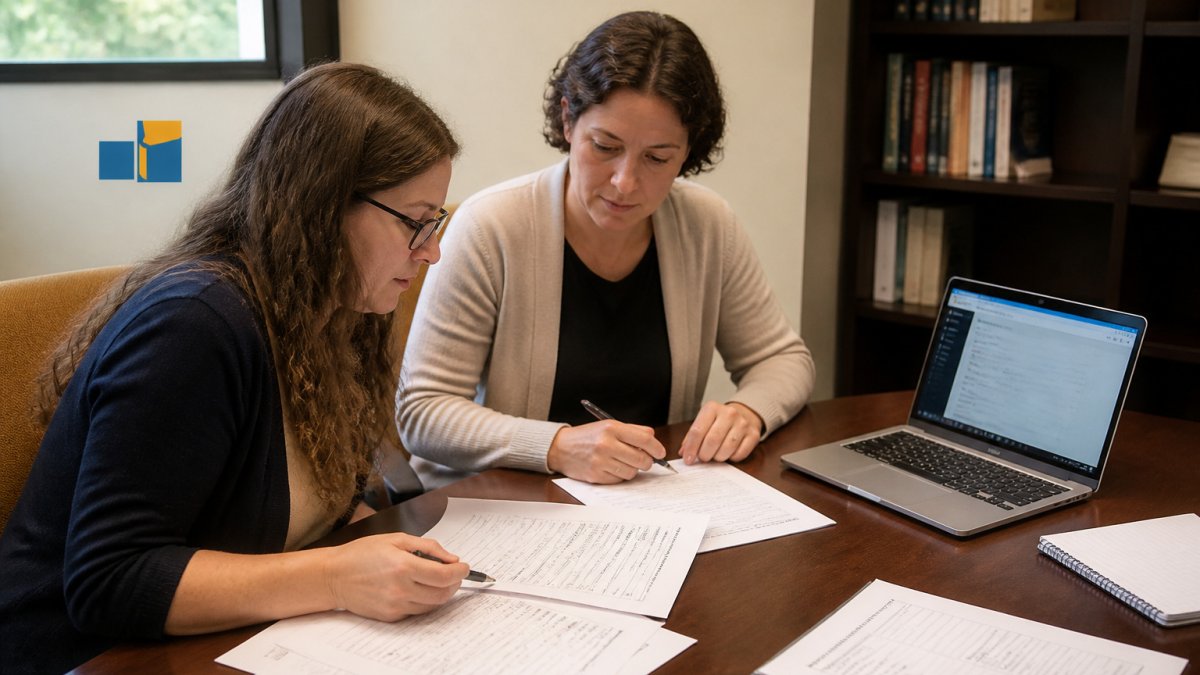
Scoping the audit and pulling learning outcomes
Start by deciding which courses and assessments are in scope. Then gather the documents you need:
- The official course outcomes from the catalog or syllabus
- Every assessment with its instructions, questions, and point values
- Any rubrics, answer keys, and grading notes
- Student performance data from the learning platform
Map each assessment to the outcome it is supposed to measure in a simple matrix. List outcomes down the left column and assessments across the top. Put an X where an assessment targets an outcome. Gaps show up fast. An outcome with no X is a finding. An assessment row with no X may not belong in the course. Keep the matrix in the audit file so reviewers can see the logic later.
Scoring each assessment against a rubric
Score each assessment on a 1 to 3 scale across four criteria. Use the anchors below so two reviewers land in the same place.
| Criterion | 1 (weak) | 2 (adequate) | 3 (strong) |
|---|---|---|---|
| Validity | Tests recall or trivia unrelated to the outcome | Partly targets the outcome but misses key verbs | Directly requires the outcome's skill or knowledge |
| Reliability | No rubric or key, or graders disagree often | Rubric exists but leaves room for interpretation | Rubric has observable anchors and calibration notes |
| Integrity | Answers are widely shared or AI-completable in one prompt | Some exposure but requires student-specific work | Requires applied, personal, or process evidence |
| Accessibility | Blocks screen readers, captions, or accommodations | Works with fixes requested case by case | Meets accessibility standards out of the box |
Keep scoring notes specific. "Needs more rigor" tells the course team nothing. "Question 4 asks for a definition that appears verbatim in the reading" gives them something to fix. Record the evidence source next to each score, such as the syllabus, the item analysis report, or a sample of graded work.
The reusable audit checklist
Copy this list into your audit file and check each item as you go.
- Every outcome maps to at least one assessment
- Every assessment maps to at least one outcome
- Each assessment has a rubric or answer key with observable anchors
- Two reviewers scored a sample and agreed within one point
- Item analysis reviewed for questions everyone misses or everyone aces
- Question banks checked for circulation and AI-completability
- Timed tests and media checked for accommodations, captions, and screen reader support
- Findings ranked by risk and effort, with an owner and a due date
Turning scores into a prioritized fix list
A score is only useful if it becomes a task. Sort findings into three buckets: fix now (integrity or accessibility problems that affect grades), fix next term (validity and alignment gaps), and monitor (reliability issues that need calibration data). Give each item an owner, a due date, and a way to verify the fix, such as a re-scored sample or a new item analysis report.
Formative vs Summative Assessment in Online Learning: What to Check
Formative assessments check learning during the course. Summative assessments measure learning at the end. Both matter, but they need different things from an audit.
Check that formative tasks give students quick, useful feedback. Quizzes with no feedback teach little. Check that summative tasks carry a fair share of the grade and test the full set of outcomes, not just the easiest ones.
A useful test: if a student fails the summative assessment, can the formative work explain why? If the answer is no, the two are not connected.
Academic Integrity in Online Assessments: Common Audit Findings
Academic integrity problems are among the most common findings in online course audits. The usual culprits are:
- Question banks that have circulated for years
- Open-book exams that test lookup skills instead of understanding
- Take-home essays with prompts that generative AI answers well
- Discussion posts that reward generic agreement
How to audit for integrity, not just spot problems
Treat integrity as a review of task design, security controls, and student evidence. For each high-stakes assessment, ask three questions and record the answers in the audit file.
- Can the task be completed without the student's own work? Check whether the prompt can be answered by a search, a shared bank, or a single AI prompt. Try the prompt yourself and note how close a generic answer gets.
- What evidence proves the work is the student's? Look for process artifacts such as drafts, version history, short recorded explanations, or in-class application. Identity verification and proctoring are options, but they carry privacy and equity costs that belong in the finding.
- What does the platform data show? Compare score patterns, answer similarity, and timing. Clusters of identical wrong answers or unusually fast completions are signals to investigate, not proof of misconduct.
Redesign moves that hold up better than surveillance
Fixes do not have to mean heavy proctoring. Often the better move is to redesign the task. Ask students to apply a concept to a case they study, reflect on their own process, or defend a choice in a short recorded explanation. These tasks are harder to fake and usually better at measuring learning.
Weigh the trade-offs honestly. Lockdown browsers and remote proctoring can reduce some cheating, but they raise privacy questions, create accommodation burdens, and can erode trust. Document why you chose a control, what data it collects, and how students can request an alternative. That record is part of the audit evidence.
What to put in the integrity finding
Write each finding with four parts: the assessment, the exposure (how the work could be faked), the evidence (prompt test, platform data, or sample review), and the recommended fix with an owner. Rank integrity findings by risk to grades and accreditation, and revisit them after the next term's data comes in.
Accessibility and Learning-Platform Data in Your Audit
Accessibility belongs in every audit. Check that quizzes work with screen readers, that timed tests offer accommodations where policy requires them, and that video or audio content has captions and transcripts.
Your learning management system also holds useful evidence. Look at item analysis reports, completion rates, and score distributions. A question that nearly everyone gets wrong may be badly written. A question that everyone gets right may be too easy to tell students apart.
Use this data as a starting point for conversations with faculty, not as a verdict on their teaching.
Booking Your First Assessment Audit with Babb Education
If you want an outside team to run the audit, Babb Education offers an Assessment Transformation Audit. You keep full ownership of your intellectual property.
Pricing depends on the number of courses, the timeline, and the depth of review, so we provide a quote based on your scope.
For faculty who want help putting the findings into practice, our faculty professional development sessions cover assessment design and rubric calibration. If you are ready to talk through your courses, reach out through our website and tell us which programs you want reviewed first.
Frequently Asked Questions
What is the purpose of an assessment audit in higher education?
An assessment audit checks whether the tests, projects, and quizzes in a course measure the learning outcomes the course claims to teach. It looks at alignment between objectives and assessments, the clarity of grading criteria, the balance of formative and summative work, and whether students can complete the tasks through the platform without barriers. Colleges and universities use audits to find gaps before a new term starts, so faculty can revise weak items instead of discovering problems through low pass rates or student complaints.
How often should colleges and universities audit their online course assessments?
Many institutions review high-enrollment and gateway courses every term or every year, and audit the rest on a rotating schedule that fits their course refresh cycle. A course should also be reviewed after a major LMS change, a shift in faculty, or a spike in grade complaints or integrity concerns. The right cadence depends on enrollment, program accreditation requirements, and how quickly your assessments date. Starting with your largest courses usually gives the fastest return.
How do you evaluate the effectiveness of online course assessments?
Effectiveness shows up in several places: whether the assessment matches the stated learning outcome, whether scores are consistent across similar students and sections, whether item-level results show questions that most students either miss or answer too easily, and whether students can explain their feedback and act on it. Pairing rubric scores with learning-platform analytics, such as attempt counts and time-on-task, helps separate a poorly written item from a content gap in the course.
Can I use an online course audit checklist for every course?
Yes, a single checklist works across disciplines if it covers alignment, clarity, accessibility, feedback quality, and integrity safeguards. Each department can add discipline-specific items, such as lab simulations or writing criteria. Keep the checklist short enough that a reviewer can complete it for one course in a few hours, and store completed checklists alongside your course documentation so changes can be tracked from term to term.